Monthly Archives: January 2018

Wisdom and the Four Gospels (Wisdom 2:10-20)

The Crucifixion of Christ

The Crucifixion of Christ

Regarding the allusions to the Apocrypha in the New Testament, let us begin our discussion with an examination of an extended passage from the Wisdom of Solomon. In Wisdom chapter 2, we have a description of the ungodly man and his reaction to and oppression of the righteous. This passage is generally applicable to the relationship between the ungodly and the righteous person, whoever he (or she) may be; however, this passage is specifically applicable to the relationship between Jesus (the ultimate Righteous Man), and the religious and political leaders of His day. I would argue that the gospels are the fulfillment of this passage from the Wisdom of Solomon. With that in mind, let us examine this passage.

Let us oppress the poor righteous man, let us not spare the widow, nor reverence the ancient gray hairs of the aged. (Wisdom 2:10)

This passage begins with the oppression of the poor, which is a recurring theme of the Old and New Testaments. The book of Proverbs goes so far as to say: “A righteous man regardeth the life of his beast: but the tender mercies of the wicked are cruel” (Pr 12:10). Not only does a righteous man care for the poor man and the aged, but also the creatures entrusted to his care (Gen 1:26).

Let our strength be the law of justice: for that which is feeble is found to be nothing worth. (Wisdom 2:11)

The ungodly use the law against the poor, the aged, and all of creation. To the ungodly, obedience to the letter of the law excuses a lack of mercy. Against this argument, the prophet Hosea argues that God desires mercy rather than sacrifice (Hos 6:6). To those who pride themselves on their adherence to the law, Jesus argues that judgment, mercy, and faith are the “weightier matters of the law”, which must be done without neglecting the law itself (Matt 23:23).

Therefore let us lie in wait for the righteous; because he is not for our turn, and he is clean contrary to our doings: he upbraideth us with our offending the law, and objecteth to our infamy the transgressings of our education. (Wisdom 2:12)

Here is where this passage takes a turn; while generally applicable to the relationship between the ungodly and the righteous, from this point onward this passage is specifically applies to the relationship between the ungodly and The Righteous One, who is Jesus Christ. In the Gospels we read how Jesus upbraided the religious leaders, and how they in turn plotted against him. We read how they tried to trap Jesus with questions designed to elicit answers which would have been unsatisfactory to the people or would have put Him at odds with the Roman authorities. (The question regarding whether it was lawful to pay taxes to the Roman authorities comes to mind; see Matt 22:17ff)

He professeth to have the knowledge of God: and he calleth himself the child of the Lord. (Wisdom 2:13)

This is most certainly true of Our Lord. The first example of this is found in the story of the Boy Jesus in His Father’s house. Not only were the teachers astonished at His understanding, but when His parent’s upbraided Him, Jesus asked them why they didn’t know He must be about His Father’s business (Luk 2:41-50).

He was made to reprove our thoughts. (Wisdom 2:14)

This passage is fulfilled in the healing of the man with palsy (Matt 9:1-8). Jesus first announces to the man the forgiveness of sins, which the scribes thought was blasphemous, because only God can forgive sins. Jesus reproved them for their thoughts, after which he demonstrating that He had the power to forgive sins by healing the palsied man.

He is grievous unto us even to behold: for his life is not like other men’s, his ways are of another fashion. (Wisdom 2:15)

In the Gospel of Luke, we read how Jesus called Levi the tax collector, who then gave a great feast at his house with other tax collectors present. Seeing this, the “scribes and Pharisees complained against His disciples, saying, ‘Why do You eat and drink with tax collectors and sinners?'” Jesus response was that just as a physician ministers not to those who are well, but those who are sick, so too He ministered not to those who presumed themselves to be righteous, but those who knew themselves to be sinners (Luk 5:30-31). Later, while dining with Simon the Pharisee, a sinful women came in “began to wash His feet with her tears, and wiped them with the hair of her head: and she kissed His feed and anointed them with the fragrant oil.” At this, the Pharisee murmured in his heart against Jesus for allowing Himself to be touched by a sinful woman. Jesus then rebuked the Pharisee for failing to follow the standards of hospitality by having Jesus’ feet washed before dinner, whereas the sinful woman had done this and more. Therefore to the woman he said her sins were forgiven, and that her faith had saved her (Luk 7:36-50). To the Lawyer who sought to justify himself in his own eyes, Jesus gave the Parable of the Good Samaritan, in which the Priest and Levite are the villains, while the hated Samaritan was the hero for showing mercy to someone to whom he had no relationship, no kinship, and no expectation of reward (Luk 10:25-37).

We are esteemed of him as counterfeits: he abstaineth from our ways as from filthiness: he pronounceth the end of the just to be blessed, and maketh his boast that God is his father. (Wisdom 2:16)

In the Gospel of Matthew, Jesus denounces the counterfeit religiosity of the Pharisees, those who “make clean the outside of the cup and of the platter, but within they are full of extortion and excess” (Matt 23:25). In the Beatitudes, Jesus pronounces the blessedness of the righteous (Matt 5:3-12). The gospels use the life of Christ as an illustration of this passage from Wisdom; the good works that Jesus does enrage the ungodly, as does his description of God as His Father (Luke 10:22; John 5:28; 10:30). Thus the three clauses from this verse are applicable to the life of Christ.

Let us see if his words be true: and let us prove what shall happen in the end of him. For if the just man be the son of God, he will help him, and deliver him from the hand of his enemies. Let us examine him with despitefulness and torture, that we may know his meekness, and prove his patience. Let us condemn him with a shameful death: for by his own saying he shall be respected. (Wisdom 2:17-20)

These final verses describe the state of mind and the actions of the Chief Priests and Pharisees regarding the death of Christ. Not only that, but they specifically foretell the words of the rulers of the Jews at the foot of the cross.

The Jewish trial was done contrary to the law, using false witnesses (Matt 26:59). After accusing Jesus of blasphemy, the scribes and elders spit in Jesus face and beat him with their hands, mocking him by saying: “Prophesy unto us, thou Christ, Who is he that smote thee? (Matt 26:67-68). After delivering Jesus to the Pontius Pilate, the Romans stripped him, whipped him, put a crown of thorns on His head, mocked Him, and crucified Him (Matt 27:27-31; Joh 19:1-18).

During Jesus’ examination before the Sanhedrin, Jesus said nothing, until he was asked whether he was “the Christ, the Son of God” (Mark 14:53-62). During Jesus’ examination before Herod, Jesus said nothing (Luk 23:6-9). Jesus did not try to justify Himself, nor did he beg for mercy, but “as a sheep before her shearers is dumb, so he openeth not his mouth” (Isa 53:7).

There was nothing more shameful than to be stripped naked and die a criminal’s death on the cross. The gospels state not only that the Jewish leaders desired the death of Jesus, but they specifically wanted the Romans to crucify Him (Joh 19:6). The author of Hebrews states that Jesus “endured the cross, despising the shame”, and is now seated at the right hand of God. (Heb 12:2).

Finally, at the foot of the cross the rulers of the Jews use the words from Wisdom to mock Christ. They sneer: “He saved others; let him save himself, if he be Christ, the chosen of God” (Luk 23:35). This is then taken up by the soldiers who mock Christ, saying: “If thou be the king of the Jews, save thyself” (Luk 23:37). Finally, one of the thieves crucified with Christ blasphemes: “If thou be Christ, save thyself and us” (Luk 23:39).

It is quite clear that this passage from Wisdom is prophetic, in that it is broadly descriptive of the life and death of Christ. Therefore, the arguments of some that the Apocrypha are not prophetic and therefore are not scripture fall to the ground.[1]


[1] Normal Geisler and Ralph MacKenzie write: “Contrary to the Roman Catholic argument from Christian usage, the true test of canonicity is propheticity. There is strong evidence that the apocryphal books are not prophetic. But since propheticity is the test for canonicity, this would eliminate the Apocrypha from the canon.” (Geisler and MacKenzie 1995, 196-197)


Bibliography

Geisler, N. L., & MacKenzie, R. E. (1995). Roman Catholics and Evangelicals: agreements and differences. Grand Rapids: Baker Books.

 

How to Read the Bible and Why

Potograph of St. Justin Popovich

St. Justin Popovich

HOW TO READ THE BIBLE AND WHY

by Archimandrite Justin Popovich

The Bible is in a sense a biography of God in this world. In it the Indescribable One has in a sense described Himself.

The Holy Scriptures of the New Testament are a biog­raphy of the incarnate God in this world. In them it is related how God, in order to reveal Himself to men, sent God the Logos, who took on flesh and became man–and as a man told men everything that God is, everything that God wants from this world and the people in it.

God the Logos revealed God’s plan for the world and God’s love for the world. God the Word spoke to men about God with the help of words, insofar as human words can con­tain the uncontainable God.

All that is necessary for this world and the people in it–the Lord has stated in the Bible. In it He has given the answers to all questions. There is no question which can torment the human soul, and not find its answer, either directly or in­directly in the Bible.

Men cannot devise more questions than there are answers in the Bible. If you fail to find the answer to any of your questions in the Bible, it means that you have either posed a sense-less question or did not know how to read the Bible and did not finish reading the answer in it.

In the Bible God has made known:

[1] what the world is; where it came from; why it exists; where it is heading; how it will end;

[2] what man is; where he comes from; where he is going; what he is made of; what his purpose is; how he will end;

[3] what animals and plants are; what their purpose is; what they are used for;

[4] what good is; where it comes from; what it leads to; what its purpose is; how it is attained;

[5] what evil is; where it comes from; how it came to exist; why it exists–how it will come to an end;

[6] what the righteous are and what sinners are; how a sin­ner becomes righteous and how an arrogant flghteous man becomes a sinner; how a man serves God and how he serves satan; the whole path from good to evil, and from God to satan;

[7] everything–from the beginning to the end; man’s entire path from the body to God, from his conception in the womb to his resurrection from the dead;

[8] what the history of the world is, the history of heaven and earth, the history of mankind; what their path, purpose, and end are.

In the Bible God has said absolutely everything that was necessary to be said to men. The biography of every man-­everyone without exception–is found in the Bible.

In it each of us can find himself portrayed and thoroughly described in detail: all those virtues and vices which you have and can have and cannot have.

You will find the paths on which your own soul and everyone else’s journey from sin to siniessness, and the entire path from man to God and from man to Satan. You will find the means to free yourself from sin.

In short, you will find the complete history of sin and sin­fulness, and the complete history of righteousness and the righteous.

If you are mournful, you will find consolation in the Bible; if you are sad, you will find joy; if you are angry–tranquility; if you are lustful–continence; if you are foolish–wisdom; if you are bad–goodness; if you are a criminal–mercy and righteousness; if you hate your fellow man–love.

In it you will find a remedy for all your vices and weak points, and nourishment for all your virtues and accomplishments.

If you are good, the Bible will teach you how to become better; if you are kind, it will teach you angelic tenderness; if you are intelligent, it will teach you wisdom.

If you appreciate the beauty and music of literary style, there is nothing more beautiful or more moving than what is contained in Job, Isaiah, Solomon, David, John the Theologian and the Apostle Paul. Here music–the angelic music of the eternal truth of God–is clothed in human words.

The more one reads and studies the Bible, the more he finds reasons to study it as often and as frequently as he can. According to St. John Chrysostom, it is like an aromatic root, which produces more and more aroma the more it is rubbed.

Just as important as knowing why we should read the Bible is knowing how we should read the Bible.

The best guides for this are the holy Fathers, headed by St. John Chrysostom who, in a manner of speaking, has written a fifth Gospel.

The holy Fathers recommend serious preparation before reading and studying the Bible; but of what does this preparation consist?

First of all in prayer. Pray to the Lord to illuminate your mind–so that you may understand the words of the Bible–and to fill your heart with His grace–so that you may feel the truth and life of those words.

Be aware that these are God’s words, which He is speaking and saying to you personally. Prayer, together with the other virtues found in the Gospel, is the best preparation a person can have for understanding the Bible.

How should we read the Bible? Prayerfully and reverently, for in each word there is another drop of eternal truth, and all the words together make up the boundless ocean of the Eternal Truth.

The Bible is not a book but life; because its words are “spirit and life” (John 6:63). Therefore its words can be comprehended if we study them with the spirit of its spirit, and with the life of its life.

It is a book that must be read with life–by putting it into practice. One should first live it, and then understand it.

Here the words of the Saviour apply: “Whoever is willing to do it–will understand that this teaching is from God” (John 7:17). Do it, so that you may understand it. This is the fun­damental rule of Orthodox exegesis.

At first one usually reads the Bible quickly, and then more and more slowly, until finally he will begin to read not even word by word, because in each word he is discovering an everlasting truth and an ineffable mystery.

Every day read at least one chapter from the Old and the New Testament; but side by side with this put a virtue from each into practice. Practice it until it becomes a habit to you.

Let us say, for instance, that the first virtue is forgiveness of insults. Let this be your daily obligation. And along with it pray to the Lord: “O gentle Lord, grant me love towards those who insult me!”

And when you have made this virtue into a habit, each of the other virtues after it will be easier for you, and so on until the final one.

The main thing is to read the Bible as much as possible. When the mind does not understand, the heart will feel; and if neither the mind understands nor the heart feels, read it over again, because by reading it you are sowing God’s words in your soul.

And there they will not perish, but will gradually and imperceptibly pass into the nature of your soul; and there will happen to you what the Saviour said about the man who “casts seed on the ground, and sleeps and rises night and day, and the seed sprouts and grows, while the man does not know it” (Mark 4:26-27).

The main thing is: sow, and it is God who causes and allows what is sown to grow (1 Cor. 3:6). But do not rush success, lest you become like a man who sows today, but tomorrow already wants to reap.

By reading the Bible you are adding yeast to the dough of your soul and body, which gradually expands and fills the soul until it has thoroughly permeated it and makes it rise with the truth and righteousness of the Gospel.

In every instance, the Saviour’s parable about the sower and the seed can be applied to every one of us. The seed of Divine Truth is given to us in the Bible.

By reading it, we sow that seed in our own soul. It falls on the rocky and thorny ground of our soul, but a little also falls on the good soil of our heart–and bears fruit.

And when you catch sight of the fruit and taste it, the sweetness and joy will spur you to clear and plow the rocky and thorny areas of your soul and sow it with the seed of the word of God.

Do you know when a man is wise in the sight of Christ the Lord? –When he listens to His word and carries it out. The beginning of wisdom is to listen to God’s word (Matt. 7:24-25).

Every word of the Saviour has the power and the might to heal both physical and spiritual ailments. “Say the word and my servant will be healed” (Matt. 8:8). The Saviour said the word–and the centurion’s servant was healed.

Just as He once did, the Lord even now ceaselessly says His words to you, to me, and to all of us. But we must pause, and immerse ourselves in them and receive them–with the centurion’s faith.

And a miracle will happen to us, and our souls will be healed just as the centurion’s servant was healed. For it is related in the Gospel that they brought many possessed people to Him, and He drove out the spirits with a word, and healed all the sick (Matt. 8:16).

He still does this today, because the Lord Jesus “is the same yesterday and today and forever” (Heb. 13:8)

Those who do not listen to God’s words will be judged at the Dreadful Judgment, and it will be worse for them on the Day of Judgment than it was for Sodom and Gomorrah (Matt. 10:14-15).

Beware–at the Dreadful Judgment you will be asked to give an account for what you have done with the words of God, whether you have listened to them and kept them, whether you have rejoiced in them or been ashamed of them.

If you have been ashamed of them, the Lord will also be ashamed of you when He comes in the glory of His Father together with the holy angels (Mark 8:38).

There are few words of men that are not vain and idle. Thus there are few words for which we do not mind being judged (Matt. 12:36).

In order to avoid this, we must study and learn the words of God from the Bible and make them our own; for God proclaimed them to men so that they might accept them, and by means of them also accept the Truth of God itself. In each word of the Saviour there is more eternity and permanence than in all of heaven and earth with all their history.

Hence He said: “Heaven and earth will pass away, but my words will not pass away” (Matt. 24:35). This means that God and all that is of God is in the Saviour’s words. Therefore they cannot pass away.

If a man accepts them, he is more permanent than heaven and earth, because there is a power in them that immortalizes man and makes him eternal.

Learning and fulfilling the words of God makes a person a relative of the Lord Jesus. He Himself revealed this when He said: “My mother and my brothers are those who hear the word of God and carry it out” (Luke 8:21).

This means that if you hear and read the word of God, you are a half-brother of Christ. If you carry it out, you are a full brother of Christ. And that is a joy and privilege greater than that of the angels.

In learning from the Bible, a certain blessedness floods the soul which resembles nothing on earth. The Saviour spoke about this when He said, “Blessed are those who hear the word of God and keep it” (Luke 11:28).

Great is the mystery of the word–so great that the second Person of the Holy Trinity, Christ the Lord, is called “the Word” or “the Logos” in the Bible.

God is the Word (John 1:1). All those words which come from the eternal and absolute Word are full of God, Divine Truth, Eternity, and Righteousness. If you listen to them, you are listening to God. If you read them, you are reading the direct words of God.

God the Word became flesh, became man (John 1:14), and mute, stuttering man began to proclaim the words of the eternal truth and righteousness of God.

In the Saviour’s words there is a certain elixir of immortality, which drips drop by drop into the soul of the man who reads His words and brings his soul from death to life, from impermanence to permanence.

The Saviour indicated this when He said: “Truly, truly I say unto you, whoever listens to my word and believes in the One who sent me has eternal life …and has passed over from death to life” (John 5:24).

Thus the Saviour makes the crucial assertion: “Truly, truly I say unto you, whoever keeps my words will never see death” (John 8:51).

Every word of Christ is full of God. Thus, when it enters a man’s soul it cleanses it from every defilement. From each of His words comes a power that cleanses us from sin.

Hence at the Mystical Supper the Saviour told His disciples, who used to listen to His word without ceasing: “You have already been cleansed by the word which I have spoken to you” (John 15:3).

Christ the Lord and His Apostles call everything that is written in the Bible the word of God, the word of the Lord (John 17:14; Acts 6:2, 13:46, 16:32, 19:20; II Cor. 2:17; Col. 1:15, II Thess. 3:1), and uniess you read it and receive it as such, you will remain in the mute, stuttering words of men, vain and idle.

Every word of God is full of God’s Truth, which sanctifies the soul for all eternity once it enters it.

Thus does the Saviour turn to His heaveniy Father in prayer: “Father! Sanctify them with Thy Truth; Thy word is truth” (John 17:17).

If you do not accept the word of Christ as the word of God, as the word of the Truth, then falsehood and the father of lies within you is rebelling against it.

In every word of the Saviour there is much that is supernatural and full of grace, and this is what sheds grace on the soul of man when the word of Christ visits it.

Therefore the Holy Apostle calls the whole structure of the house of salvation “the word of the grace of God” (Acts 20:32).

Like a living grace-filled power, the word of God has a wonder-working and life-giving effect on a man, so long as he hears it with faith and receives it with faith (1 Thess. 2:13).

Everything is defiled by sin, but everything is cleansed by the word of God and prayer–everything–all creation from man on down to a worm (1 Tim. 4:5).

By the Truth which it carries in itself and by the Power which it has in itself, the word of God is “sharper than any sword and pierces to the point of dividing soul and spirit, joints and marrow, and discerns the thoughts and intentions of the heart” (Heb. 4:12). Nothing remains secret before it or for it.

Because every word of God contains the eternal Word of God–the Logos-it has the power to give birth and regenerate men. And when a man is born of the Word, he is born of the Truth.

For this reason St. James the Apostle writes to the Christians that God the Father has brought them forth “by the word of truth” (1:18); and St. Peter tells them that they “have been born anew…by the word of the living God, which abides forever” (1 Peter 1:23).

All the words of God, which God has spoken to men, come from the Eternal Word–the Logos, who is the Word of life and bestows Life eternal.

By living for the Word, a man brings himself from death to life. By filling himself with eternal life, a man becomes a conqueror of death and “a partaker of the Divine nature” (2 Peter 1:4), and of his blessedness there shall be no end.

The main and most important point of all this is faith and feeling love towards Christ the Lord, because the mystery of every word of God is opened beneath the warmth of that feeling, just as the petals of a fragrant flower are opened beneath the warmth of the sun’s rays. Amen.


The Apocrypha and Greek Philosophy

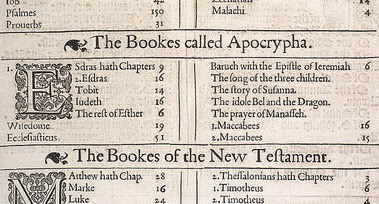
The Books called Apocrypha

The Bookes called Apocrypha

Alfred Edersheim notes that one of the reasons why the Apocrypha was written was to find some way to reconcile Greek philosophy with previous Jewish writings. The object was apologetic, to demonstrate that the Hebrew Scriptures were every bit the equal of the Greek philosophers. In particular, Edersheim notes the Apocrypha combined Plato’s speculations with the asceticism of the Stoics.[1]

Of course, by linking Greek philosophy with the Old Testament, the Apocrypha paved the way for the New Testament’s use of the terminology of Greek philosophy. The connections between Platonism, Stoicism, and the New Testament are well documented (if only in the use of the terminology). Donald Robinson mentions the “traces of Stoicism in the New Testament”, especially in the epistles of the Apostle Paul — specifically in Paul’s sermon at the Areopagus (Acts 17:18-32), where Paul quotes from two different Greek poems, including a student of Zeno, the founder of Stoicism.[2]

Scholars have identified the first as coming from the Cretica of the pre-Socratic philosopher-poet Epimenides (fl. 7th or 6th century BC), which forms part of the verse:

They fashioned a tomb for you, holy and high one,

Cretans, always liars,[3] evil beasts, idle bellies.

But you are not dead: you live and abide forever,

For in you we live and move and have our being.[4]

The second has been identified as coming from the Phaenomena of the philosopher-poet Aratus (315/310 – 240 BC), a student of Zeno, the founder of Stoicism:

Let us begin with Zeus, whom we mortals never leave unspoken.

For every street, every market-place is full of Zeus.

Even the sea and the harbour are full of this deity.

Everywhere everyone is indebted to Zeus.

For we are indeed his offspring…[5] [6]

Paul again quotes Epimenides in his pastoral letter to Titus when he writes: “One of themselves, even a prophet of their own, said, The Cretians are alway liars, evil beasts, slow bellies. This witness is true.” (Titus 1:12-13a)

Bibliography

Edersheim, Alfred. 1993. The Life and Times of Jesus the Messiah: New Updated Edition. Peabody: Hendrickson Publishers, Inc.

Robertson, Donald. 2012. “St. Paul on Stoicism: From the Acts of the Apostles.” Stoicism and the Art of Happiness. November 10. Accessed January 20, 2014. http://philosophy-of-cbt.com/2012/11/10/st-paul-on-stoicism-from-the-acts-of-the-apostles/.

[1] (Edersheim 1993, 22)

[2] (Robertson 2012)

[3] Titus 1:12

[4] Acts 17:25

[5] Acts 17:28

[6] (Robertson 2012)

The Book of Adam and Eve

Expulsion of Adam and Eve from Paradise

Expulsion of Adam and Eve from Paradise

The Book of Adam and Eve is a Christian work written by a pious Egyptian in the 5th or 6th century. The author is evidently documenting what Christians then believed. The author lived about the time when the Byzantine Empire was at its largest extent. Because the document was valuable enough to have been copied and translated, it is reasonable to assume the Book of Adam and Eve accurately reflects Christian belief of the post-Nicene Church.

There are a number of things in this book suggesting the Protestant Reformation was not a recovery of ancient Christianity. For example, the early Church did not believe the Calvinist doctrine of double predestination, as the following quote makes clear.

And the Lord said unto Adam and Eve, “You transgressed
of your own free will, until you came out of the garden in which I had placed you. Of your own free will have you transgressed through your desire for divinity, greatness, and an exalted state, such as I have; so that I deprived you of the bright nature in which you then were, and I made you come out of the garden to this land, rough and full of trouble.”

First, it is made clear that Adam and Eve sinned of their own free will. It was their choice to sin, and God did not stop them. Moreover, God created Adam and Eve with free will, even knowing they would sin.

For I knew you would sin and transgress. …
Yet I would not [force you, nor] be hard upon you,
nor shut you up; nor doom you through your fall.
For I made you of the light; and I willed to bring out
children of light from you, and like unto you.
But you did not keep one day My commandment; until I
had finished the creation and blessed everything in it.

The ancient Church did not believe that God forces anyone against their will. Indeed, the early Church believed the human will was free, and that humanity could choose for and against God. It troubles me when some deny the existence of free will, for they are basically equating their description of the human person with the scriptural description of the idol. In the book of Jeremiah, we read:

Thus saith the LORD, Learn not the way of the heathen, and be not dismayed at the signs of heaven; for the heathen are dismayed at them. For the customs of the people are vain: for one cutteth a tree out of the forest, the work of the hands of the workman, with the axe. They deck it with silver and with gold; they fasten it with nails and with hammers, that it move not. They are upright as the palm tree, but speak not: they must needs be borne, because they cannot go. Be not afraid of them; for they cannot do evil, neither also is it in them to do good. (Jer 10:2-5)

One of the interesting points Jeremiah makes is that idols are made and fashioned to match a certain image, but that they lack free will. They do not move of their own volition, but must be borne everywhere. They do not speak, so someone must speak for them. They are entirely passive; just as it is not in them to do good, so also it is not in them to do evil.

What we believe about humanity necessarily affects what we believe about God. The bible tells us we were made in the image and likeness of God. In saying the human being has no volition and is merely is passive, Calvinists make humanity into something impotent. This necessarily implies something about the One in whose image we were made. If we are not free beings created in the image and likeness of God, then it could be argued that God is not free either. If God acts of necessity or compulsion, then God is no God at all, but only a being like unto us.

The Calvinist argument is different. In formulating their Doctrine of Man (also known as Theological Anthropology), Protestants begin with the fall. This is different from ancient Christianity, for as we see in the Book of Adam and Eve, they began with the creation; the fall is accounted for God’s ultimate plan, but does not change the basic nature of humanity. Calvinists, in particular, see the fall as total, and that humanity after the fall is evil; that God chooses some to be saved and others to be lost, and that the decision to believe is not up to us, but is predestined and is forced upon us by God. This is not what the ancient Church believed. As we read in the Book of Adam and Eve, God does not force Himself upon us, nor does He doom us by our fall.

Sin is a sickness that adheres to our humanity, a disease we need healing from. The sin that so easily besets us prevents us from enjoying full communion with God. The Book of Adam and Eve tells us that instead of seeing the world through spiritual eyes, we see only with our eyes of flesh, and see only material things.

When you were under subjection [to Me], you hadst a bright nature within you, and for that reason you could see things afar off. But after your transgression your bright nature was withdrawn from you; and it was not left to you to see things afar off, but only near at hand; after the ability of the flesh.

Our bright nature has withdrawn but is not destroyed. The sin that so easily besets us prevents the expression of the image of God from being significantly expressed within us, yet that nature still exists. Thanks be to God.

The Old Testament and Second Temple Judaism

Herod's Rebuilt Second Temple

Herod’s Rebuilt Second Temple

The idea of the canon as a list of authoritative books would have been strange to Jews of the Second Temple period. For them, the Temple was the center of their religion. Lester L. Grabbe, Emeritus Professor of Hebrew Bible and Early Judaism at the University of Hull, England, writes:

It is natural that people often assume that Judaism in the Second Temple period was more or less like contemporary Judaism, in which people meet weekly or even more frequently in synagogues to pray, worship, and hear the Bible read. The written scripture and its reading and study are assumed to be the focus of Judaism at all times. …Yet the Judaism of pre-70 times was formally structured in a quite different way from the Judaism of later times. The main religious institution was the Jerusalem temple, and temple worship went back many centuries in Jewish and Israelite history. …The main activity in the temple was blood sacrifice.[1]

Lester L. Grabbe goes on to discuss the issue of the supposed canon during Second Temple Judaism.

When and how the present canon became finalized is still not known, despite a number of studies on the subject. Some Jewish groups seem to have accepted a different set of books as authoritative compared to other groups.[2]

Jaroslav Pelikan agrees with Grabbe, and writes:

Not only is the use of the word canon as a designation for an authoritative list of sacred books a rather late phenomenon within the history of the Jewish community, but even the idea of a fixed and final list came about only after a long evolution.[3]

Julio Trebolle Barrera notes the idea of a canon was foreign to the Jewish mind. He notes the word canon is a term connected to “New Testament studies,” and Jews did not use it until “the 4th cent. CE.” He writes:

To apply the term «canon» to the Hebrew Bible, therefore, is quite unsuitable. Hebrew has no term which corresponds to Greek «canon». Rabbinic discussions concerning the canonical or apocryphal character of certain biblical books such as Song of Songs and Qoheleth, turn on the expression «defiles the hands». The supposition is that books of which it is said that «they defile the hands» were considered as canonical, whereas books to which this expression was not applied were excluded from the biblical canon. However, the expression «defile the hands» may have no more significance than to refer to ritual purification to be performed after having used such books and before starting any other secular activity.[4]

Saying Hebrew has no term corresponding to the Greek word ‘canon’ is not precisely true. The Greek word ‘canon’ is itself a loan word from the Semitic languages. In Hebrew, the word is קָנֶה (qaneh) meaning ‘tube’ or ‘reed’. The Hebrew word qaneh is related to the Assyrian word qanu and the Arabic word qanah, meaning ‘hollow stick’ or ‘reed’. While the Greeks and Christians used the word canon in the sense of a rule or measuring stick, this idea comes from Greek philosophy.

The concept of canon as the rule of faith is a Christian idea that developed rather late. The Jews eventually used that idea for the Hebrew Scriptures, but such an idea was unknown in Jesus’ day. Jewish groups knew which books they considered to be Scripture, but there were different Jewish groups with competing ideas as to the extent of their scriptures. More importantly, the concept of canon was a gentile concept; as such it would likely not have been used by Jews to delimit their Scriptures to a specific set of books.

The Swiss Protestant theologian Robert Hanhart, writing in the introduction to Martin Hengel’s “The Septuagint as Christian Scripture”, notes that Jesus ben Sirach’s introduction to Sirach (aka Ecclesiasticus) “assumes the three divisions transmitted by the Masoretes”, and draws a distinction between the material described by these divisions and that of his translation of his grandfather’s commentary on Scripture.[5] He concludes that Second Temple Judaism distinguished between canon and Apocrypha. By stating this, Robert Hanhart is reading the medieval Masoretic traditions back into the Second Temple period, two periods separated by nearly a millennium. Lutheran professor and theologian Emil Schürer differs with Robert Hanhart: “The most ancient testimony to the collocation of both collections with the Thorah [sic] is the prologue to the Book of Wisdom. …We cannot, however, determine from it that the third collection was then already concluded.”[6]

The disagreement between Robert Hanhart and Emil Schürer illustrates the manner in which scholars disagree regarding the boundaries of the Old Testament canon in the second temple period and reflects the wide range of perspectives among Jews of the second temple period. The Baptist Professor Jeff S. Anderson writes about the diversity existing within Second Temple Judaism.

What flourished in the Second Temple Period was not a single, fixed, “normative” Judaism, but a developing, evolving religion… No straight evolutionary line of the Jewish faith emerges. Consequently, it is preferable to speak of multiple Judaisms rather than a monolithic ideology that views one brand of Judaism as orthodox and the rest as “sects.” All Judaisms, consequently, competed for an audience and for the authority that accompanies broad-based acceptance.[7]

Epiphanius of Salamis (c. 310–320 – 403 CE) describes twelve specific sects of the Jews: the Samaritans, the Essenes, the Sebuaeans, the Gorothenes, the Dositheans, the Sadducees, the Scribes, the Pharisees, the Hemerobaptists, the Nasaraeans, the Ossaeans, and the Herodians.[8] The Jerusalem Talmud (c. 200 – 400 CE) quotes Rabbi Johanan as saying there were twenty-four heretical sects of Judaism in the time of Ezekiel.[9] With different Judaisms competing for acceptance, it is no wonder there was no consensus on the limits of the Hebrew Scriptures.[10] The great Protestant scholar of Second Temple Judaism, Martin Hengel, writes:

We cannot prove the existence of a genuine Jewish, pre-Christian collection of canonical value, unambiguously and clearly delimited, distinguishable through its greater scope from the canon of the Hebrew Bible in the realm of the historical books and wisdom writings and written in Greek. Nor, especially, can it be shown that such a ‘canon’ was already formed in pre-Christian Alexandria. One can only proceed from the fact that the five books of Moses’ Torah, the so-called Pentateuch, were translated into Greek under Ptolemy II Philadelphus (282-246), at the latest toward the middle of the third century [BC].[11]

The picture of Second Temple Judaism is much more complex than is commonly thought. There was the temple cult centered in Jerusalem, and there was the law which Jews agreed was scripture. Most Jews accepted the Prophets as well. Beyond that, we know different branches of Judaism accepted a varying list of writings as authoritative, and possibly as scripture. The canon of the Hebrew Scriptures was not settled until well into the Christian era.

Endnotes

  1. (Grabbe 2010, Kindle Locations 536-538; 540-541)
  2. (Grabbe 2010, Kindle Locations 561-562)
  3. (Pelikan 2005, 39)
  4. (Barrera 1998, 148)
  5. (Hengel, The Septuagint as Christian Scripture 2002, 2-3)
  6. (Schürer, A History of the Jewish People, Second Division, Volume 1 1890, 308)
  7. (Anderson 2002, 5-6)
  8. (Epiphanius of Salamis 2012, Book 1, Section 1, Parts 9-20)
  9. (Bowker 1973, 161) The Jerusalem Talmud was written well into the Christian era, in a period after many of the competing Judaisms had died out. Thus, the reference to them as ‘heretical sects.’
  10. The scholar April D. DeConick writes: “Judaism and Christianity are companion expressions of Second Temple Judaism, sibling religions that developed simultaneously within comparable historical contextures.” (DeConick 2006, 3)
  11. (Hengel, The Septuagint as Christian Scripture 2002, 19)

Bibliography

  1. Anderson, J. S. (2002). The Internal Diversification of Second Temple Judaism: An Introduction to the Second Temple Period. Lanham: University Press of America, Inc.
  2. Barrera, J. T. (1998). The Jewish Bible and the Christian Bible; An Introduction to the History of the Text. (W. G. Watson, Trans.) Grand Rapids: Wm. B. Eerdmans Publishing Co.
  3. Bowker, J. (1973). Jesus and the Pharisees. New York: Cambridge University Press.
  4. DeConick, A. D. (2006). What is Early Jewish and Christian Mysticism? Retrieved August 7, 2017, from Jewish Roots of Eastern Christian Mysticism: http://www.marquette.edu/maqom/definition.pdf
  5. Epiphanius of Salamis. (2012, April 25). The Panarion of Epiphanius of Salamis: A Treatise Against Eighty Sects in Three Books. Retrieved October 22, 2016, from Masseiana Home Page: http://www.masseiana.org/panarion_bk1.htm
  6. Grabbe, L. L. (2010). An Introduction to Second Temple Judaism (Kindle Edition ed.). New York: T&T Clark.
  7. Pelikan, J. (2005). Whose Bible Is It: A Short History of the Scriptures (Kindle Edition ed.). New York: Penguin Group US.
  8. Schürer, E. (1890). A History of the Jewish People in the Time of Christ (Vols. Second Division, Volume 1). (S. Taylor, & P. Christie, Trans.) Edinburgh: T & T Clark.

The Broad and Truncated Canons of the Old Testament

The Books called Apocrypha

The Books called Apocrypha

The Christian Church accepted the broader canon of the Old Testament (including the Apocrypha) until the time of the Reformation. The Anglican Henry Wace, in his commentary on the King James Version, admits as much when he writes:

When the Reformers denied the inspired authority of the books of the Apocrypha, it was by no means their intention to exclude them from use either in public or in private reading. The Articles of the Church of England quote with approbation the ruling of St. Jerome, that though the Church does not use these books for establishment of doctrine, it reads them for example of life and instruction of manners.[1]

Having already truncated their canon, some Protestants look back to the ancient church for support, citing this or that authority who seemingly support their position. There were individuals who devised lists of books approved for use in the church, such as the listing called the “ruling of St. Jerome.” These lists are occasionally similar to the canon used by Protestants today, but these individual lists were not authoritative in the wider church. Even where the lists of Old Testament books matched those of the Protestant canon, these lists wouldn’t match the New Testament books — and vice versa. (We will provide more detail on this later). St. Jerome was not a bishop, and the ‘ruling of St. Jerome’ was not authoritative anywhere. St. Jerome ultimately accepted the ruling of his bishop, something noted by Martin Hengel: “Jerome himself, who was not only a great and combative scholar but also a smooth diplomat, largely abandoned any effort to defend the Hebrew original in the Apocrypha question.”[2]

St. Athanasius (c. 296-373) is widely cited as having provided the first complete listing of the 27 books of the New Testament. Matt Slick, the President and Founder of the Christian Apologetics and Research Ministry (CARM), cites Festal Letter 39 (c. 367 A.D.) as proof that Athanasius condemns the Apocrypha.[3] This is only partially correct. First of all, St. Athanasius was speaking for his own diocese, not the entire Church. Second, there were many different lists being advanced for centuries afterwards.

While St. Athanasius did not approve of all the so-called Apocrypha, his festal letter approved several of them. For example, his list contains “the first and second of the Chronicles are reckoned as one book”; “Jeremiah with Baruch”; “Lamentations, and the epistle, one book”; Esther; and Daniel. Baruch is one of the so-called Apocrypha, as is the Epistle of Jeremiah. The versions of 2 Chronicles, Esther, and Daniel judged by St. Athanasius as genuine contain material Protestants judge to be Apocryphal.[4] In the unabridged King James Version, these are called “The Prayer of Manassas” (placed at the end of 2 Chronicles); “The rest of Esther” (material found throughout Esther in the Septuagint); “The History of Susanna” (comes before Daniel chapter 1); “The Song of the Three Holy Children” (comes in the middle of Daniel chap. 3); and “Bel and the Dragon” (comes after Daniel chap. 12). To be honest, if Protestants want to claim Festal Letter 39 of St. Athanasius as sealing the canon of the New Testament, they should also be prepared to accept all the Old Testament Apocrypha cited by Athanasius.

In his book The Divine Names, the author known today as Pseudo-Dionysius (late 5th to early 6th century) quotes from the Wisdom of Solomon, describing it as “introductory Scriptures.”[5] We might be tempted towards thinking this supports the general Protestant view. Paul Rorem and John Lamoreaux say the term “introductory Scripture” merely means that the Old Testament was an introduction to the New; in other words, the entire Old Testament could be termed “introductory Scripture.”[6] The question, then, is how extensive that introduction is.

Among early Protestants, there was substantial disagreement and confusion as to the extent of the Old Testament. For example, John Wycliffe’s Bible translation, first hand-printed in 1382 A.D., contains 48 Old Testament books, as opposed to the 39 contained in the Protestant Old Testament.[7]  We should note the Bibles printed following the Protestant Reformation also include what Protestants call the Apocrypha.[8] For example, Martin Luther’s German translation of 1522 contained the Apocrypha. The English Language Matthew-Tyndale Bible, published by John Rogers in 1537, contained the Apocrypha.[9] Both the Geneva Bible of 1560 and the original King James Version (KJV) of 1611 contained the Apocrypha. Unabridged editions of the KJV with the Apocrypha are still available today, although printed versions are rare in the United States.[10]

Abridged Bibles without the Apocrypha are an American invention. The Continental Congress approved and funded the printing of Bibles without the Apocrypha. Rev. Dr. Will Gafney writes:

Many are unaware that the shorter Protestant bible was created in the new America, during the revolutionary war when a printer took it upon himself without the authority of a church council to print a bible whose contents he chose. That bible, The Aitken Bible[11] is also significant for having been printed with the authority of the Continental Congress.[12]

Modern Protestants use a truncated canon whose origins and history they are unaware of. Moreover, they misread the canonical history of the Old Testament. This does not mean Protestants cannot be saved, of course. What it does mean is that Protestants lack the fullness of the faith.

Endnotes

[1] (Wace 1811, xxxvi) The ruling of St. Jerome was his private theological opinion, was contrary to the practice of the wider Christian Church, and was not accepted as dogma anywhere.

[2] (Hengel, The Septuagint as Christian Scripture 2002, 49-50)

[3] (Slick 2014)

[4] The Masoretic text favored by many conservative Protestant scholars did not exist at this time. The favored text in the Church was the Septuagint (see chap. 4.)

[5] (Pseudo-Dionysius, the Areopagite 1987, 81)

[6] (Rorem and Lamoreaux 1998, 48)

[7] The various eBooks and online sources like Bible Gateway only reproduce the part of Wycliffe’s translation that are acceptable to the Protestants. Wycliffe’s complete Old Testament contained the following books considered unacceptable after the Reformation: 1 Esdras, 2 Esdras, 3 Esdras, Tobit, Judith, Wisdom (Wisdom of Solomon), Syrach (Sirach, a.k.a. Ecclesiasticus), Preier of Jeremiah (Epistle of Jeremiah), Baruk (Baruch), along with 1 Machabeis & 2 Machabeis (1st and 2nd Maccabees). John Wycliffe’s New Testament also contains Paul’s letter to the Laodiceans, a contested document found in no generally accepted version or translation. (Wycliffe 2008)

[8] When asked if The Online Bible (www.onlinebible.net) would be providing a copy of the original King James Version with the Apocrypha,   Larry Pierce, (the founder) responded: “We have no intention of mixing Jewish fables with the infallible Word of God.” (Pierce 2014) Pierce is quoting Titus 1:14 here, equating Paul’s reference to ‘Jewish fables’ with the Apocrypha, an interpretation that cannot be found in the text. Pierce chooses to use an abridged version of the King James Version rather than provide it as it was originally printed. In an email to Pastor EJ Hill, Larry Pierce admitted to redacting and editing other people’s work when they do not agree with his theology (such as Thayer’s 1889 Greek-English Lexicon.) (Hill 2012)

[9] The Matthew-Tyndale Bible, generally known as the Matthew Bible, contains the following books not found in the Protestant Bible: 1 Esdras, 2 Esdras, Tobit, Judith, Rest of Esther, Wisdom of Solomon, Ecclesiasticus, Baruch, 3 Holy Children, Suzanna, Bel & the Dragon, Prayer of Mannesah, 1 Maccabees, and 2 Maccabees. (Rogers and Coverdale 1537)

[10] An excellent resource is the Official King James version online which contains the American truncation of the King James Version, the Apocrypha, and the original 1611 version with the apocrypha. http://www.kingjamesbibleonline.org/Apocrypha-Books/

[11] http://www.theworldsgreatbooks.com/Aitken Bible.htm

[12] (Gafney 2013)

Bibliography

Gafney, W. C. (2013, March 17). Jesus’ Bible and the History Channel’s Bible. Retrieved December 7, 2014, from The Rev. Wil Gafney, Ph.D.: http://www.wilgafney.com/2013/03/17/jesus-bible-and-the-history-channels-bible/

Hengel, M. (2002). The Septuagint as Christian Scripture. Grand Rapids: Baker Academic.

Hill, E. (2012). Did Larry Pierce abridge Thayer’s Lexicon? The Online Bible Forum. Winterbourne: Online Bible.

Pierce, L. (2014, May 5). “email conversation”. Online Bible Tech Support. Winterbourne: Online Bible.

Pseudo-Dionysius, the Areopagite. (1987). Pseudo-Dionysius: The Complete Works. (C. Luibheid, Trans.) New York: Paulist Press.

Rogers, J., & Coverdale, M. (1537). 1537 Matthew’s Bible. Retrieved September 1, 2014, from Bibles-Online.net: http://www.bibles-online.net/1537/

Rorem, P., & Lamoreaux, J. C. (1998). John of Scythopolis and the Dionysian Corpus: Annotating the Areopagite. Oxford: Clarendon Press.

Slick, M. (2014, November 1). Apocrypha. Retrieved June 23, 2016, from CARM: http://carm.org/early-church-fathers-apocrypha

Wace, H. (1811). Holy Bible According to the Authorized Version (A.D. 1611). (Vol. 1). (H. Wace, Ed.) London: John Murray.


Beauty in Fragility

Nassim Nicholas Taleb - Antifragile

Nassim Nicholas Taleb

Today I did something in 90 minutes that would have taken days or weeks just a few years ago — and would only have been possible if I lived in a large city with a huge research library, or somewhere with access to a robust system of inter-library loans. I was reading through an old, out-of-print book by Georges Florovsky when I came across a quote attributed to someone by the name of Khomyakov. The end note referenced a page number from a book entitled Russia and the English Church. There was no bibliography, so all I had were those two clues. (Russians aren’t as picky as we are about the manner in which sources are cited.)

A quick internet search later and I discovered a book of the same title available on Amazon.com. The book was written by William Palmer and was a record of a correspondence between him and one Alexis Stepanovich Khomiakoff (note the different spelling of Khomyakov). One quick search on Google Books and I found a scanned copy of this public domain book available for download. A few minutes later and I had the complete quote added to my book.

We take this stuff for granted today, yet within the lifetime of nearly any adult, this would have been the stuff of science fiction. And yet the devices we use to do all this are themselves incredibly fragile and dependent upon a surprisingly fragile infrastructure.

Imagine if you took your smartphone on a trek across the Sahara desert. In an hour or so you would be out of cell range. No worries, everything else works just fine. Until the battery goes dead, and you’re screwed. Imagine you were somehow transported back in time, much like the main character in Mark Twain’s A Connecticut Yankee in King Arthur’s Court. You have this marvelous device, but lack the infrastructure that makes it useful. No GPS, so you have no way of figuring out where you are. No internet, so you can’t download new content or update existing content. And, within a day or two, your battery is dead and you’re screwed. Suppose you had the foresight to bring along a solar charger; you would have no infrastructure to support your smartphone, but at least you have all the content you’ve downloaded. Until, inevitably, the battery wears out, the phone breaks, etc.

This marvel I hold in my hand allows me to do beautiful things, yet it is so terribly fragile. In his book Antifragile, Nassim Nicholas Taleb defines fragility as anything that has more downside than upside from random events or certain shocks. Taleb writes: “Man-made complex systems tend to develop cascades and runaway chains of reactions that decrease, even eliminate, predictability and cause outsized events. So the modern world may be increasing in technological knowledge, but, paradoxically, it is making things a lot more unpredictable.” [1] The entire infrastructure that makes my smartphone and my computer do such beautiful things is incredibly interconnected and dependent upon that interconnectedness. The infrastructure is fragile; it doesn’t take much to take the entire system down. Moreover, the computer I’m writing on can be easily destroyed by a random power surge. I have increased the robustness of my computer by attaching it to a surge-protected Uninterruptible Power Supply (UPS), but that merely masks the inherent fragility of my computer.

Today I did something beautiful and almost miraculous. And yet everything that made it possible could all be gone in a flash.

[1]Taleb, Nassim Nicholas (2012-11-27). Antifragile: Things That Gain from Disorder (Incerto) (Kindle Locations 400-402). Random House Publishing Group. Kindle Edition.